
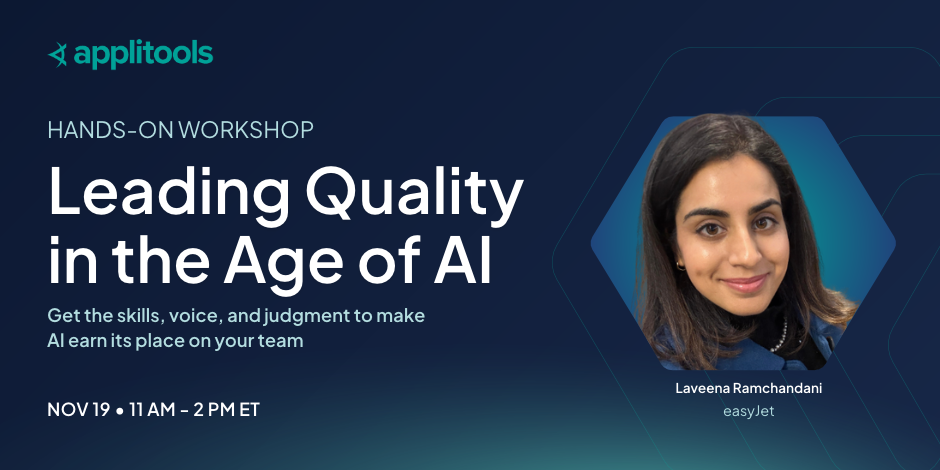
As AI coding agents accelerate software release velocity, the biggest career opportunity for quality engineers isn't tactical test maintenance—it's stepping into strategic quality leadership.
Applitools is hosting an interactive workshop with quality engineering leader Laveena Ramchandani to give you the practical tools, guardrails, and metrics to step into leadership and manage quality at scale—from risk tiering and data-backed release criteria to controlling hidden AI costs.
Butch's Take
A year and a half ago I built my first RAG system to store company documents, using a ChatGPT model and a chat interface to answer questions about our API and product documentation. It made a lot of mistakes, and as I tested it I formed a lot of opinions about what was possible with LLM tools. My use of ChatGPT, GitHub Copilot and Cursor during that time added to those opinions. The tools were really good at answering a specific question or a short back and forth, but when I tried to offload real work to them, it often took longer to get the tool to do something than to just do it myself. So I put them in a “box.” Fine for small stuff, not ready for the larger multi-step problems I was working on. At the time that was a fair call. The problem is I kept holding onto that opinion long after the tools had improved.
That started to change in January, when I went through some trainings that pushed past what I thought LLMs could do. I watched an agent explore a webapp and provide an overview of what features existed. This showed me how much my earlier experience was holding me back from trying new things or asking for more. It was also when MCP, CLIs and agent skills started showing up on the teams I work with, so it wasn’t just the models getting better. Everything around them was changing too. That’s when it clicked for me that every time a new model or harness comes out, what I believe about it is really a belief about the last one. Now I try to rebuild my mental model with each new model release: try the thing the previous model struggled with, and see what actually happens. As testers we should be good at this. We don’t trust last sprint’s test results to tell us about this sprint’s build, so why trust a last year's opinion of a model that’s been replaced multiple times since?
What’s changed most for me is that I’ve pushed myself to be more ambitious with my asks. Not “write me a test” with a wall of HTML pasted in, but “here’s an updated redesign, explore the app with playwright-cli and build out the e2e tests with clear assertions.” Every time I’ve asked for more, I’ve walked away impressed by what’s possible. These tools aren’t doing the thinking for me. I’m still the one leading and guiding, but I’m leading a lot more work than I used to. That’s where the “aha” moments happen, and they only happen when I let go of what I thought these tools couldn’t do.
So if you formed your opinions about AI a while back, treat them like an old test result. Take the latest model, pick the task you were sure it couldn’t do, and run it again. Give it something bigger than you think it can handle, and find out which of your beliefs is outdated.
Headlines & Launches
Has AI Made Us Forget the SDLC?
Stephen Platten -
The Stoic Tester (LinkedIn)
A veteran tester's argument that AI development runs the SDLC backwards: the app gets built first, then AI reverse-engineers requirements from what exists and generates tests against them - 'AI marking its own homework.' Everything looks consistent while nothing is checked against original business intent. Shift-left spent years winning; over-the-fence testing is back and worse, and independent validation needs grounding beyond the solution itself.
Catching Bugs Before They Land: JiTTesting's Human-on-the-Loop Approach at Full Scale
Meta Engineering (Engineering at Meta)
Meta reports production results for Catching JiTTests, which generates executable tests designed to fail against risky diffs before they land. Two workflows (dodgy diff mutation testing, intent-aware mutant construction) feed weak catches through an LLM-as-Judge ensemble plus a deterministic rule-based assessor, with humans setting policy instead of reviewing each item. Numbers: 60% true positives, 74 privacy bugs caught pre-landing, 20% drop in privacy bugs during the timeframe.
Apple Ships Official Xcode Plugin for Claude Code
0xMarioNawfal (X)
Apple's official Xcode plugin (listed in Claude Code's plugin directory, authored by Apple) gives the agent build, run, and test control, SwiftUI preview rendering, simulator and real-device driving, build log reading, and Apple developer docs search. Corroborated by Anthropic: Xcode 26.3 also embeds the Claude Agent SDK natively.
Codex Fixed 213 Broken Tests at OpenAI in Six Weeks for $32 an Hour
Codex Insider (Codex Insider)
OpenAI's DevDay described a Codex run pointed at CI failures for six weeks from a 200-word prompt: 1,000+ hours, 213 merged fixes, 600 Slack messages, ~500k tool calls, 5,800 subagent sessions. Given an outcome, not a plan, it self-organized into orchestration plus subagents, escalated GPU-vs-software questions to researchers, and had second agents review test deletions. Cost worked out to $16-32 an hour.
Tools & Frameworks
Cloudflare Security Audit Skill: Multi-Phase Audits with Independently Verified Findings
Cloudflare (GitHub)
Cloudflare open-sourced the coding-agent skill behind its vulnerability discovery harness: a six-phase audit pipeline (recon, coverage-led hunting, candidate validation, structured findings, independent verification, reporting) with machine-readable outputs validated at every phase. Core rule: the agent that checks a finding is never the agent that found it. Single runs found roughly half the vulnerabilities that repeated runs found in total.
Gauge CLI: Measure Whether Coding Agents Can Actually Use Your Product
Gauge (GitHub)
The open-source Gauge CLI runs real coding agents (Claude Code, Codex, Pi, OpenCode) against your product in Docker and captures where they get stuck: interactive commands that block agents, deprecated API patterns, skills that go unused, confidently claimed limitations that don't exist. A hillclimb loop evaluates, analyzes, and retests working-tree changes with baseline-vs-candidate batches. Local execution needs no account.
Trowser Goes Open Source
Rikard Edgren (The Test Eye)
Rikard Edgren open-sources Trowser, the tester's browser for exploratory web-service testing by humans and AI together, under MIT. New in the announcement: collaborative journal, peer sessions with live BOLA checks, and a testing shadow with custom laws. He applied Weinberg's Rule of Three to the decision, reversing his earlier stance of restricting releases he feared were too powerful, and invites contributors. LLM use is unrestricted, but decisions stay human.
Postman Adds Scripts and Tests to MCP Requests
Danny Dainton (LinkedIn)
Postman's MCP support now includes scripts and tests: connect to an MCP server, inspect its exposed tools, prompts, and resources, then assert on every tool call and resource read, all runnable in the Collection Runner alongside regular HTTP requests. MCP server testing gets the same workflow discipline as API testing. Announced by Postman's Danny Dainton; official release notes not yet published.
E2E for .NET: Plain-Language Goals with Locator Checks and Replay
Dario Kondratiuk (hardkoded.com)
A community .NET port of the e2e framework: tests describe goals in plain language, an LLM drives the app across web, iOS, Android, MAUI, and Windows, while assertions use locator-based checks with no model call. Verified actions are recorded and replayed without the model until the screen stops matching, cutting cost and nondeterminism on reruns.
A Tool-Agnostic Library of QA Automation Agents and Skills
Douglas Urrea Ocampo (GitHub)
MIT-licensed library from SDET Douglas Urrea Ocampo: 7 agents (QA Orchestrator enforcing a Test Constitution, Playwright planner/generator/healer, API, Selenium, refactor specialists) plus 10 skills covering E2E, accessibility at WCAG 2.2 AA, ISTQB-aligned planning, and flaky-test investigation. Designed to be copied into real projects across Copilot, Claude Code, Cursor, OpenCode, and Windsurf, with lean non-negotiable instructions (locator priority, no hard waits, single-tag classification).
Foundations
How to Talk to AI
Kristin Jackvony (Thinking Tester)
Kristin Jackvony's five rules for AI interaction aimed at testers new to it: treat the AI as a tool rather than a friend (tokens cost money), verify every answer it gives (Air Canada chatbot example), constrain outputs by specifying the end result and length, set explicit guardrail limits before delegating tasks, and replace vague questions with specific diagnostic ones.
Techniques & Tutorials
20 Prompt-Injection Test Cases to Run Against Your AI Agent Before Launch
Elroot Labs (Elroot Labs)
A template of 20 indirect prompt-injection test cases grouped by vector: retrieved documents, tool output, email bodies, web pages, and file metadata. Each case has a code-checkable pass rule: grade actions and canaries, never the model's wording, since a polite refusal followed by a tool call still fails. NIST AgentDojo data: repeating attacks 25 times raised success rates from 57% to 80%. Fix order: remove capability, gate the action, break the trifecta.
Joshua Judges Ruth: Building Document-Injection Defenses for an AI Financial-Filing Tool
Tom Clancy (tomclancy.info)
A practitioner builds prompt-injection attacks against a PDF financial-filing tool (white-on-white numbers, off-page text, fake SEC-rule footnotes), then defends with a Swiss cheese stack of single-purpose judges: hidden-ink pixel scans, text-vs-raster divergence, Unicode obfuscation checks, screen-reader-only payload detection, glyph overlap, and non-text ink diffs. Each judge's blind spots are catalogued honestly.
Detecting Flaky Tests and Finding Their Root Causes with Strands Agents and Gemini
Alicia Marianne Goncalves (DEV Community)
A QA engineer builds flaky-test-detector: JUnit XML results grouped by test and commit, scored as flaky when the same commit produces mixed pass/fail outcomes, ranked by ratio, then a Strands SDK agent with Gemini reads the error messages of flagged tests and writes a root-cause report. The architecture keeps deterministic scoring first and LLM analysis second, bounding inference to the flagged tests.
Quick Links
Hide Your Slop PR Descriptions Behind a Collapsed Section
Simon Willison (simonwillison.net)
Simon Willison's workflow tip for agent-opened PRs: write a short human-curated opening paragraph, then collapse the full agent-written description inside a details-summary element labeled with the model name. The promise to readers: the opener reflects human editorial judgment about what's worth their time. Cheap, and it applies anywhere agents produce walls of accurate text.
Flaky Tests Are a Source of Bad Conclusions for Coding Agents
Cici (X)
A checklist on flaky tests in agent workflows: agents that see red, change code, rerun, see green conclude their fix worked. Mitigations include a machine-readable known-flaky list, runner output marking known flakies out of scope, two consecutive passes before claiming a fix, and mandatory disclosure when a PR edits both a test and its code.
Vitest's Agent-Aware Reporter: Don't Accidentally Switch It Off
Thilak (X)
Vitest 4.1+ detects coding agents and prints only failures: no passing test names, no logs from passing tests. Setting reporters in config (to add junit) disables that detection, and the agent reads 14x more output. Fix: spread configDefaults.reporters and append your own. Also check package.json for --reporter=verbose, and use AI_AGENT=1 when detection fails.
Why One Team Deleted 19% of Their Test Suite
Krishna Kapadia (LinkedIn)
A LinkedIn post arguing agents' ease of generating white-box unit tests produced suites coupled to implementation rather than behavior, so the author's team deleted thousands of them (19%). The freed budget goes to E2E flows via Playwright and formal verification with TLA+, made more accessible by skill systems like pstack. No post-deletion data included.
Are Automation Engineers Cooked? r/QualityAssurance Debates AI Test Generation
u/nishantgohel and commenters (Reddit)
An r/QualityAssurance thread on the claim that a 100-sprint automation backlog can be cleared in a day by feeding Claude the app, credentials, and manual test cases. Top field reports: generated tests mostly useless (missed bugs, duplication, overengineering) without verification. The standout comment describes hooks that reject vacuous assertions, invert assertions to prove tests can fail, and deduplicate near-duplicates.
If something in this issue made you think differently about how your team approaches AI in testing, pass it along. The best conversations about AI and QA are happening in Slack channels and stand-ups, not just newsletters.
Have something worth featuring? Reply and send it my way, I read every link.
Thanks for reading,
Butch Mayhew
