
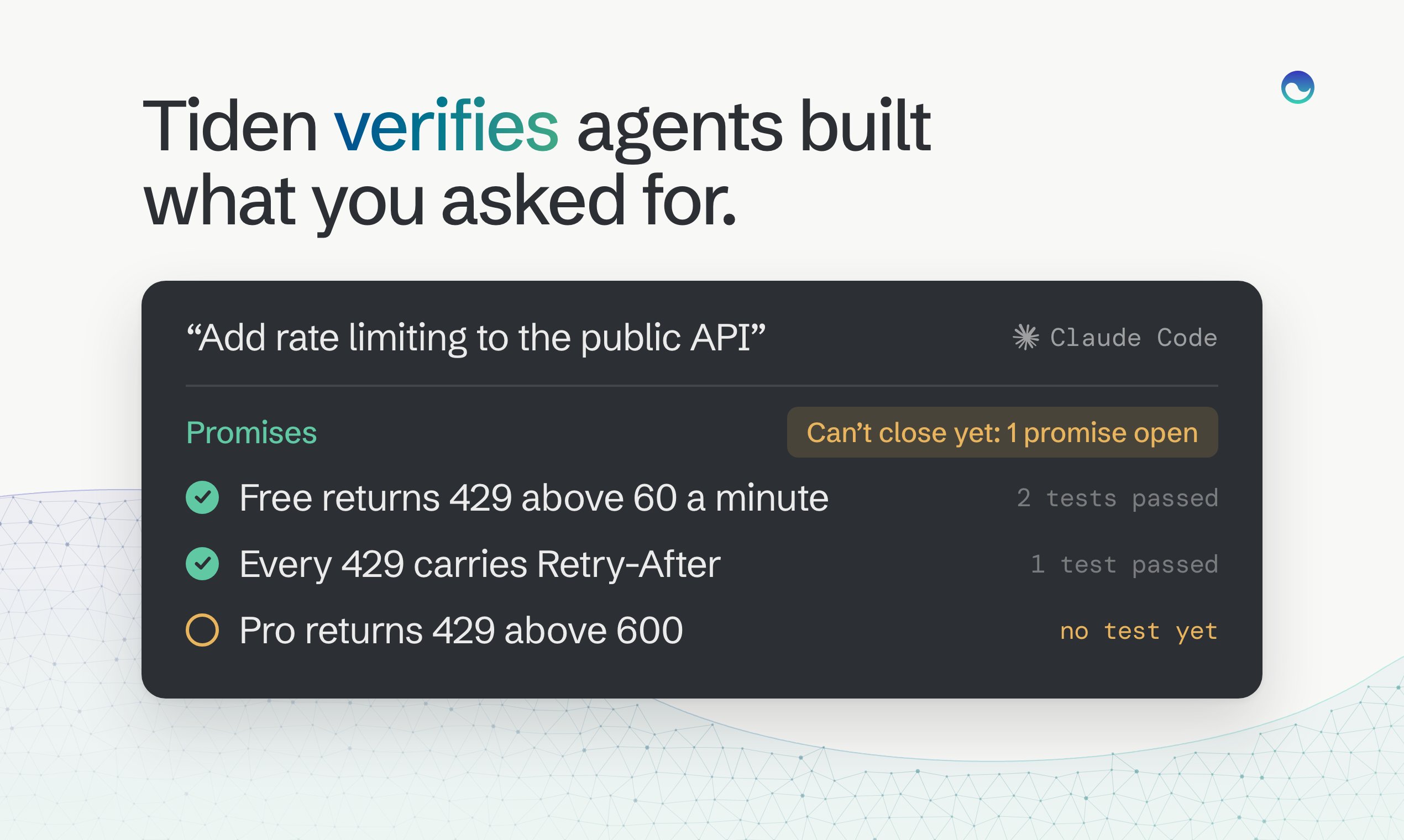
Tiden verifies that your intent is fulfilled by your coding agents. It builds and keeps an up-to-date understanding of your product from your repos, requirements, tests, and docs. It captures what you asked for, breaks that intent down into specific promises, and checks that your agents keep those promises at every stage of the SDLC.
Butch's Take
AI tools are getting very good at exploring systems and finding what can go wrong. In the last two weeks, models helped find a PHP bug that puts most of the web at risk and more than 60 critical or high Chrome CVEs. So when we talk about product quality and risk, we have to talk about security.
As you think about the risks that the products you work with, its important to consider the 10,000 foot view. This includes infrastructure, tools, third parties, packages. Some of the biggest stories this week weren't in anyone's own code. One was a vendor breach that exposed airline passenger data. Another was a batch of more than 100 malicious npm and PyPI packages. You need tools in place to watch for this stuff, because you won't catch it by hand.
But for most of us in QA, the bigger question is on the application side. Do the right user roles have the proper access controls in place? This is a great place to use an agent. Tell it, "I want to do a test around IDOR and make sure certain user levels are locked out." Let it explore every page and every way to interact with the system and build a map. Then create a lower-level user and check that they can't reach what they shouldn't. The big key is that you need documentation or a source of truth for roles and permissions to feed the agent. Without it, the agent is guessing what's expected. With it, there's a clear picture of what should and shouldn't happen, and that's what turns exploration into a real test
Security exploits + agent skills
Top exploits from the last couple of weeks
- PHP2Shell: AI-found unauthenticated RCE in core PHP, patched Oct 21
- Anthropic's model finds exploit chains in Chrome, Linux and more, 62 Chrome CVEs patched (Oct 27)
- AI coding agents hijacked with an AGENTS.md file in the Downloads folder (Oct 25)
- 106 malicious npm and PyPI packages in three days, some writing to AI assistant configs (Oct 26 to 28)
Security skills to point your agent at
- sast-idor (sast-skills): scans the codebase for missing ownership and authorization checks.
- access-control-test (awesome-claude-security): tests IDOR/BOLA, function-level access control, privilege escalation and forced browsing on an authorized target.
- Anthropic claude-code-security-review: a GitHub Action that runs an AI security review on PR diffs.
Headlines & Launches
Tester 2.0: Becoming Indispensable in the Age of AI
Filip Hric (filiphric.com)
Keynote writeup in three triads. Lies testers tell themselves: a golden age of hiring is coming, quality inevitably collapses without us, things will stay the same. Things to abandon: avoiding technical expertise, calling critical thinking our only tool, treating automation as our only tool. Strengths to build: quality-first roles like the eval engineer, the generalist perspective, and turning uncertainty into experiments. His own loop pairs a generation agent with separate-model review agents that check the ticket, rules, and blast radius, applied as early as the ticket itself.
GitHub Next Announces PDD Kit: Prove Agent Code Against a Formal Spec
GitHub Next (X)
Microsoft Research Proof Driven Development Kit, announced by GitHub Next: it discusses your code, infers intent, and proposes a formal spec in Verus, a proof language for Rust. Once you approve the spec, the Verus verifier proves the agent code meets it for every input; where proof is impossible it falls back to tests and computer-use agents. Integrated with Chopin for team planning. Rust today. Goal: a verified software factory where engineers review specifications instead of code.
Addy Osmani: Give Your Agent a Way to Verify Its Own Work
Addy Osmani (X)
The Claude Code lead at Anthropic argues better agent output comes from letting agents verify their own work, and bets verification becomes one of the year's most important problems. Warp's approach: each agent gets a computer, navigates the app it built, and posts recordings for human review, 3-4 minutes of activity edited into stitched clips. His own workflow adds Claude-recorded video and screenshots atop E2E tests as evidence work is done.
Tools & Frameworks
Your AI Agent Fixed the Bug, but What Else Did It Change?
Trail of Bits (Trail of Bits Blog)
Two agent plugins from Trail of Bits, born from Patch the Planet (with OpenAI), where a review of 130+ merged agent patches found 21 regressions. patching-bugs reproduces bugs and writes fixes with a three-arm proof: original fails, patched passes, full revert fails again. regression-hunt traces diffs to real interfaces and reproduces candidates on a live deployment; an adjudication step must disprove false positives, cutting them 25% versus a plain review prompt. No live PoC, no finding.
Basilisk: Open-Source AI Red Teaming With Genetic Prompt Evolution
Regaan (GitHub)
Open-source (AGPL) red teaming framework for LLM security, described in an SSRN paper. A genetic engine (SPE-NL) evolves adversarial prompts across generations: 10 mutation operators, crossover strategies, and multi-objective fitness with Pareto ranking. 33 attack modules map to the OWASP LLM Top 10, covering prompt injection, system prompt extraction, data exfiltration, tool abuse, RAG attacks, and multimodal injection. Findings require structured evidence and replay steps; weak proof downgrades the verdict. SARIF output and a GitHub Action gate CI.
agent-desktop: Computer Use for E2E Testing Desktop Apps With Agents
Lahfir (X)
Computer use for your agents, from a Vercel Labs engineer: E2E test desktop apps by reading the accessibility tree instead of screenshots, drill into part of a window to save tokens, and run many agents against one app in parallel. Works on macOS, Windows, and Linux; installs with one npm command. Fills the desktop gap in the agent computer-use stack, joining web and mobile options like agent-mobile and Roadie.
Lever: GitHub's Copilot Plugin for Agent Feedback Loops
GitHub (GitHub)
Official GitHub plugin of Copilot skills for agent feedback loops. /lever loop interrogates the problem until the loop is explicit: the metric, how to measure it, how noisy it is, and what counts as a win, recorded on a Loop Card the agent iterates against. Other verbs run experiment arms against a control, cross-model blind reviews reporting only agreed findings, and an autonomy dial L0 to L5 setting who merges. Read-only skills load freely; anything that pushes or files waits for an explicit command.
Foundations
Building an Agentic Software Factory? Start With the Sensor
Arjun Iyer (The New Stack)
A control-loop framing of the agentic software factory: intent is the setpoint, agents the controller, verification the sensor. A controller that outruns its sensor ships what the sensor would have caught, so autonomy is capped by the sensor, not the model. Three measurable properties: latency (time to signal), fidelity (escape rate, because agents optimize whatever the sensor rewards), and bandwidth (concurrent verification capacity). Anchored by Anthropic going from 2,500 to 30,000 merged changes a day between May and September. Vendor-sponsored, framework stands on its own.
Techniques & Tutorials
Self-Healing Tests With AI: How They Work and What They Hide
Gil Tayar (testingil.com)
Demystifies self-healing UI tests: an agent retries failed element lookups, guesses replacements, rewrites the test, and re-runs until green. Two catches: healed tests can become unreadable (tests are the live specs), and a fix that just waits longer can mask the real backend bug that made the button late. Self-healing is a hijacked term, hiding risk behind promised maintenance relief. He teaches a build-your-own version at Agile Testing Days, Nov 16.
The AI-Era CI/CD End State: Fast PR Checks, Merge Queue, Agent Swarm Staging
Richard Wu (X)
Proposes a three-tier CI/CD for AI-written code: sub-five-minute PR checks (review bots, lint, types, unit tests); a merge queue owning all expensive checks, where integration and E2E tests matter more than ever, run more not less, with agents opening fix PRs on batch failures; and continuous staging validation where an agent swarm simulates user behavior to flag anomalies deterministic tests cannot catch, like a migration locking the database.
After Test Automation: Moving the Bottleneck With Agentic Triage
Bavo Bruylandt (Medium)
A nightly 5G-over-satellite rig runs an 18-configuration radio matrix that cost half a day of triage every morning. A read-only agent reads each failed run against schema-validated defect records, separates the causal failure from its cascade, and posts a Teams card in minutes. Accepted failures are narrowly scoped and become actionable again automatically if their signature drifts. Unattended agents only publish: no ticket writes, read-only tokens, destroyed containers. Fifty red nights, then ten green.
Hot Take 🔥
Banning AI in a QA Interview Is Like Banning Stack Overflow in 2018
Erik Stepanyan (LinkedIn)
Argues QA automation interviews should allow AI, since day one on the job expects SDETs to use it to ship faster. His format: give a live app and an API doc, let candidates use their tools, and watch how they prompt, structure the framework, and fix the brittle locators and weak assertions the AI produces. Anyone can prompt an LLM to write a passing test; a real QA engineer makes sure it catches bugs.
Quick Links
Mobile MCP: Black-Box Agent Testing Finds 19 Bugs in a Customer App in Four Minutes
Gil Megidish (LinkedIn)
Mobile Next demo of Mobile MCP pointed at a customer own App Store build: no test plan, no setup, no source code. Claude Code launches the app, explores every screen, and reports bugs with steps to reproduce. This run: one crash and 18 more bugs in about four minutes. Vendor demo, but a concrete look at agent-driven exploratory testing on a real mobile build with zero preparation.
Maestro MCP for Mobile E2E: Amazing Locally, Painful on CI
Patryk Kosieradzki (X)
Months of using Maestro MCP for mobile E2E: setup is fast, tests run great locally, and writing E2E tests with agents is really fast. But on GitHub runners tests fail very often: emulators freeze, elements go invisible, and false failures come from the runner and emulator rather than the app. A concrete report of the local-versus-CI gap in agent-written mobile E2E.
QA Hiring: Now That Manual Testers Can Code, Can Automation Engineers Think Like Testers?
Yael Mizrachi (LinkedIn)
Observes that AI collapsed the old manual-versus-automation dividing line: a manual tester with Claude can build a working test framework in an afternoon. The hiring question inverts accordingly: can automation engineers still think like testers? She has interviewed candidates who build beautiful frameworks that test the wrong things. Coding ability stops being the differentiator; judging what to test becomes it.
500 Green Tests, Zero Checkouts: The Cookie Banner Incident
Rumana Parvin (LinkedIn)
A QA anecdote making the rounds: AI generates 500 checkout regression tests in two minutes, all pass on the first run, and the summary declares checkout 100% stable and ready to ship. The logs show the agent stuck on the cookie consent banner, clicking Accept 500 times without ever reaching checkout. A green report proves nothing crashed, not that the feature works. Someone still has to check what the tests actually tested.
Manual Tester Expected to Write Playwright Tests With Claude Code
/u/LinterCheck2026 (Reddit)
A manual tester with five years of experience and no framework background asks r/Playwright: leadership now expects manual testers to contribute automation, and since the company already bought Claude licenses, the stack is Claude plus Playwright. The tests pass, but he cannot tell whether they are good or whether they will break next sprint, and the SDET who reviewed them twice cannot scale. The evaluation gap, not test creation, is the bottleneck.
If something in this issue made you think differently about how your team approaches AI in testing, pass it along. The best conversations about AI and QA are happening in Slack channels and stand-ups, not just newsletters.
Have something worth featuring? Reply and send it my way, I read every link.
Thanks for reading,
Butch Mayhew
