
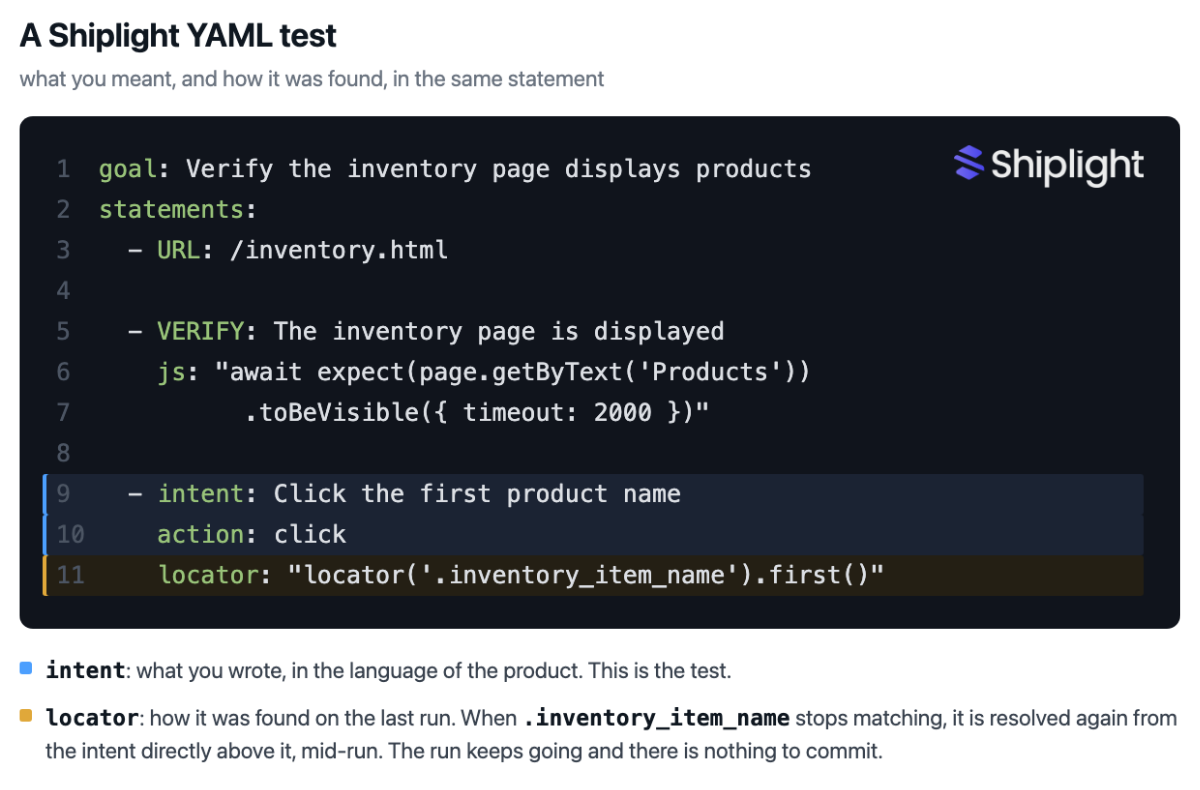
This week I ran Shiplight through a real workflow. I passed a few test cases to Claude Code using the Shiplight skill, then watched its MCP server drive a browser and explore the site on its own. What came back was a test written as readable YAML.
That YAML is the test. It captures the intent of what you want to verify, in the language of the product, which makes it far easier to read and review than generated test code.
Underneath, each statement also keeps the locator that satisfied it on the last run. That is what changes the maintenance story. When the UI moves, Shiplight re-resolves the element from the intent, regenerates the Playwright, and the run keeps going. No selector hunting and nothing to commit. If you want the repair to stick, /shiplight fix patches the YAML and opens a PR. If your app is what actually broke, it reports the bug instead of editing the test until it passes.
So the tradeoff changes: more coverage does not have to mean more maintenance.
It ships with a reporter too, so every run lands in a portal where you can see which tests are flaky and why they failed.
Butch's Take
This weekend I had a chance to listen to the Quality Remarks podcast where Keith Klain and Angie Jones had a great chat about all sorts of things AI! There is a ton of gold to be mined in this conversation that relates directly to software development and testing.
One of the big takeaways for me was a discussion of how to measure return on investment (ROI) on the usage of AI tools and agentic workflows within teams. Angie's answer: money. Did the tool, or what you built with it, increase revenue? Everyone working at a company should be asking that. Does your work and your token burn bring revenue in, or protect the revenue that's already there?
The "business minded tester" already operates this way. They report the bugs that matter to the business, not just every single bug they found. The same logic applies to AI tools... If your agents explore the app multiple times a day in a non-deterministic way and surface only low value bugs, rethink your strategy. Would you have paid for that run out of your own pocket for what you got back?
Angie also called out Tokenmaxxing as driving the wrong behavior: "In fact, I would reward people if they're able to be more productive with less token usage." The real question: what does Tokenmaxxing actually deliver, and does that output move the business?
Headlines & Launches
My Ideal AI QA Workflow: More Than Test Case Generation
Adrian How (Medium)
An AI QA workflow that starts before generation: AI examines groomed requirements for ambiguity and conflicts, drafts BDD cases for three-way review, then converts approved cases into repository-aware backend automation using layered AGENTS.md, SOP, and skill instructions. The agent sizes its own change, compiles and runs locally, leaves explicit TODOs instead of inventing, and opens a normal merge request. Humans keep every decision that matters: risk, review, accountability.
The Best AI Testing Tool Is the Repo Context You Already Have
Stepan Kars (Medium)
Stepan Kars's team shipped a year's worth of work in five months, and QA kept up without buying a new platform: he taught the tools he already had to follow the repo's own conventions — an orchestrator rule, a test-planner skill, templates, and plain-English rules like golden constants, soft assertions, and data-qa-id selectors over XPath. Customer-reported bugs halved with one tester instead of two. His claim: a general tool plus written-down repo context beats any universal tool with none.
How to Make Your SKILL.md Interactive
Filip Hric (filiphric.com)
Filip Hric shows how to add interactive option pickers inside a SKILL.md, extending Matt Pocock's grill-me planning skill. Claude Code exposes an AskUserQuestion API that Cursor also picks up; Codex has request_user_input but hides it behind a flag outside plan mode; Claude Desktop renders the picker without descriptions. A practical teardown of one interaction pattern across four harnesses, and a case for cross-tool skill compatibility.
How are you using AI in your day-to-day QA/testing?
Reddit (r/QualityAssurance)
Reddit thread where a Senior SDET shares an AI workflow: strategy .md files per repo, incident docs as context, model-switching under credit limits. Standout reply warns AI misses implied acceptance criteria and shares blind spots with dev-side AI; it also assumes test failures are bad tests, not bugs. Other workflows: failure-log triage, Cursor + Playwright MCP maintenance with curated skills, and one QA blocked by company policy against sharing code.
Tools & Frameworks
iftest: One Line = One Test
Javier González (GitHub)
A minimalist, multi-language testing format: each line of a .iftest file is evaluated as an if condition, truthy passes, falsy fails. Zero-dependency single-file runners in PHP, JS, Go, Python, bash, and Ruby. One format covers unit checks, HTTP smoke tests (curl status codes), file existence, and speed limits. NDJSON output with a stable schema and deterministic exit codes, so AI agents can generate tests, run them, and parse verdicts with no framework API to learn.
browser-test: A JavaScript Test Framework in One HTML File
Erik Swanson (GitHub)
A browser-based automated JavaScript testing framework in a single .html file. Copy it in, serve on localhost, write tests in the script block, refresh to see results. ~140 lines of human-written JS, so it is easy to audit before adopting. Tests run in a real browser, giving every browser API (DOM, IndexedDB, localStorage) and full devtools access without mocking or heavyweight automation. Jest-like API: describe, the expect family, fixtures with setup/teardown.
GitHub CLI --attach: Inline Media in Issues, PRs, and Comments
GitHub (X)
GitHub CLI's new repeatable --attach flag uploads local images or videos and references them inline in issues, pull requests, and comments, available on all plans. The QA angle is verification evidence: before/after screenshots, traces, and recorded runs can now land on the exact PR under review. Because it is CLI-driven, agents and CI pipelines can attach proof automatically. More details can be found in the Changelog.
Trowser 1.3.9: URL Completion, Journal Memory, and Mirror Mode
Rikard Edgren (LinkedIn)
Rikard Edgren ships Trowser 1.3.9, the tester's browser, named 'Trowser Thomas' after contributor Thomas Dahlman. New: URL completion (the tester's answer to bookmarks), a compact Journal that acts as memory for the built-in AI Assistant to cut token usage, and Mirror Mode that replays your actions on peer Trowser instances. Free download from thetesteye.com, with release-name suggestions open on GitHub. Edgren also notes a Ministry of Testing webinar with Rahul Parwal sharpened this release.
Mira Test Engineer: Skills for a Smaller, More Useful Test Suite
haukebri (GitHub)
Two agent skills that attack test-suite bloat instead of adding to it. Clean Test Suite maps tests against production behavior, flags circular assertions, mocked-away behavior, and redundant workflows, then proposes exact deletions with named protection losses, gated behind explicit approval; Write Good Tests keeps ongoing reminders before test work and code review. One shared skill source installs across Claude Code, Codex, Pi, and DeepSeek Harness. Deletion comes first, replacement is opt-in follow-up work.
Safari 27 Ships a Built-in MCP Server for AI Agents
Apple (developer.apple.com)
Apple's official documentation for Safari 27's built-in MCP server: run safaridriver with --mcp and connect Claude Code or Codex to 18 browser tools, including open and switch tabs, read page content as Markdown/HTML/JSON, screenshots, console and network inspection, dialogs, viewport sizing, media emulation, and click/type/scroll/keystroke interaction. Agent-controlled windows show a banner, and access sits behind an 'Allow remote automation and external agents' setting. The first major browser to ship first-party agent automation.
Foundations
Five Questions to Ask Before Creating an AI Agent
Kristin Jackvony (Think Like a Tester)
Kristin Jackvony offers five questions to ask before building an AI agent: what problem it solves, who actually wants it, what information it needs (answering this often reveals a JQL query or cron script would do the job), what its exact output should be, and who will test, monitor, and maintain it. Agents are software applications, she argues, even when built with plain language instead of code.
Techniques & Tutorials
Why Your CLAUDE or AGENTS.md File Gets Ignored
Filip Hric (LinkedIn)
Filip Hric explains why agent instruction files get silently ignored: they load at conversation start, and recency or contradictions with your live prompt can override them entirely. Use them to define intent (what this project is), not execution commands or boundaries. Then verify the output: self-checks, a second verifier agent, or a dedicated test-writing agent. Every generation needs verification.
Validate First, Then Decide Whether to Automate
Mallikarjuna Siddappa (LinkedIn)
Mallikarjuna Siddappa, after building his own AI testing tool, argues ticket-to-test generation is the wrong order: it automates behavior nobody has validated, against a build that may change tomorrow. His sequence instead: an agent validates the feature like a manual tester first, then an explicit automate/manual-only/automatable-once-changed decision, and only then a generated test with human PR review. The recorded decisions aggregate into platform fixes no single project would ever raise.
Research & Data
Your Coding Agent Says the Tests Are Done. The Coverage Report Says 31 Percent.
Anton Angelov (LinkedIn Pulse)
If a coding agent writes your team's tests, this UBC study is your reality check. The agent reported tests 'generated and verified' while branch coverage sat at 31%, skipping exactly the hard logic QA cares about. Iterating with real checks after each round (tests pass, coverage grows, or rollback) recovered most of the gap, and a learned stopping rule beat fixed retries on coverage, fault detection, and cost. Agent self-reports are not evidence.
Hot Take 🔥
AI on Playwright: A Hyperactive Junior Intern
Vadim Lagun (LinkedIn)
Vadim Lagun spent weeks pointing Claude Code and ChatGPT at Playwright. Generic prompts yield fragile 80-character XPaths, hallucinated Playwright methods that do not exist, and 60-line solutions for single-click problems. His verdict: AI is a hyperactive junior intern — good at boundary value lists, mock data, and repetitive assertions, not framework design decisions. The comment thread is the real value, including a pushback arguing the fix is a proper skill-based workflow.
Quick Links
Overcoming Anxiety in the Age of AI: Create Space Before You React
Stephen Platten (LinkedIn)
Stephen Platten's Stoic Tester column takes on AI anxiety: anxious testers rush, over-test the wrong thing, avoid hard questions, and treat AI as magic or threat instead of something to assess. The fix is a deliberate pause with four questions (what happened, what am I assuming, what's the evidence, what's the next useful action). Testing gives evidence, not certainty, and calm thinking is what keeps judgment load-bearing under AI pressure.
AI and Testers and Jobs
Pete Walen (petergwalen.com)
Pete Walen takes on the recurring question: are testers going to be out of work because of AI? Every technology shift, from 4GLs to test automation to Agile, raised the same fear, and the professionals who thrived were the ones who stayed curious. His dividing line: if your value is taking requirements at face value and generating test cases, that work competes with AI directly. Challenging assumptions, uncovering risks, and asking how things fail gets harder to replace as tools get better.
QA in a Vibe-Coded World: What the Discipline Needs Right Now
Joshua Bihun (Medium)
Joshua Bihun closes a four-part series on QA adapting to AI with the cross-cutting pieces: AI assistance every practitioner can use (bug report review, test data, accessibility guidance), the emerging specialty of testing probabilistic AI systems, the durable human skills (risk reasoning, domain knowledge, communication), and a blunt case to leadership: cutting QA investment as AI efficiency is a bet against the delivery-performance research.
If something in this issue made you think differently about how your team approaches AI in testing, pass it along. The best conversations about AI and QA are happening in Slack channels and stand-ups, not just newsletters.
Have something worth featuring? Reply and send it my way, I read every link.
Thanks for reading,
Butch Mayhew