
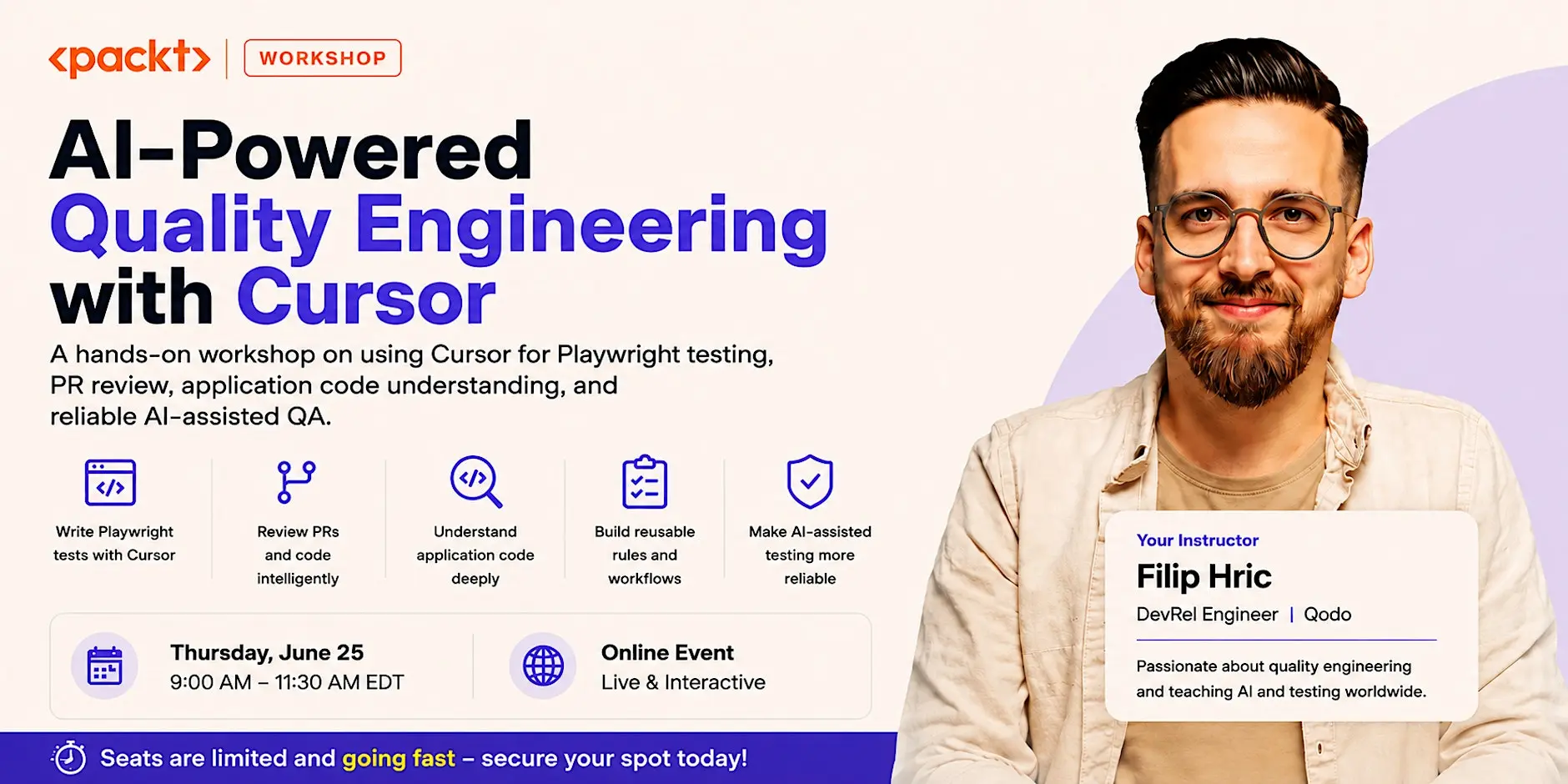
I'm excited to attend a webinar this Thursday, June 25th, 9:00-11:30 AM EDT, on using Cursor for QA work. Filip Hric iis running a hands-on workshop on exactly that: Playwright tests, PR review, reusable Cursor workflows, the whole thing. If you want to stop random-prompting and start using Cursor as a structured QA assistant, it's worth the 2.5 hours.
AI in QA Review
Butch's Take
Entelechy (pronounced en-TEL-uh-kee). I picked this word up from the final chapter of SPIN Selling by Neil Rackham, and it names something I didn't know we had a word for in English.
It means the becoming actual of what was potential: turning what you know into what you can actually do. Another way to describe this is "Turning theory into practical action". Just knowing about AI's capabilities/tools or reading about them is not enough.
Rackham gives 4 rules for actually learning a skill:
- Practice 1 behavior at a time. Get it right before you move on.
- Try a new behavior at least 3 times before you judge it. The first attempt always feels clumsy.
- Quantity before quality. Reps first, polish later.
- Practice in safe, low-stakes situations until it feels natural.
Challenge: Pick one skill you've been meaning to build up, a new tool, a new technique, whatever it is, and get some reps in. Be bad at it 3 times. That's how a tool you read about becomes one you actually use.
Headlines & Launches
To Infinity and Beyond: The Death of Test Engineering
Keith Klain (Quality Remarks)
Keith Klain's talk arguing that test engineering as a discipline is dying, not because testing itself is obsolete, but because the rigid, execution-heavy model testers built their identity around is being eroded by AI, shifted-left expectations, and changing team structures. He traces how the role got here and what comes next for people who want to stay in quality work.
AI Readiness Radar: Are You Actually Ready for AI Development?
Callum Akehurst-Ryan (cakehurstryan.com)
Callum Akehurst-Ryan argues AI won't save a dysfunctional engineering team, it'll expose it. Teams that benefit most from AI aren't the ones adopting tools fastest, they're the ones with foundations already in place. The AI Readiness Radar is a self-assessment framework with five signals: codified standards, feedback loops, trusted reviews, quality ownership, and context/understanding. Each scored across four maturity bands (none, low, moderate, high). Includes team archetypes (startup, feature factory, solo dev, mature team) and a facilitation guide for running the assessment. Designed as a conversation tool that sits underneath DORA, TMMi, and Team Topologies.
The Same Line in Every Room
Dragan Spiridonov
Dragan Spiridonov's conference tour diary (ExpoQA Madrid, Craft Budapest) that crystallizes into one argument: own your own AI. After hearing the same line in every room, he makes the case that vendor independence stopped being a preference and became the work. Covers open-weight models collapsing the cost of near-frontier capability (DeepSeek V4-Pro at 34x cheaper), local LLM judges hitting 0.997 AUROC on M-series Macs, the Fable/Mythos access restrictions, and why sovereign agentic AI infrastructure matters for QA teams.
Tools & Frameworks
Astra: AI-Powered QA Automation Ecosystem
Karishma Koul
Karishma Koul's open-source project that reads test cases from Excel, Jira, or ADO, generates Playwright Python test code using RAG + GPT-4o, then runs a second AI layer to evaluate its own output on quality and correctness before it reaches a human reviewer. Four-stage pipeline: Understand, Generate, Evaluate, Sync. Built to address QA burnout from manually translating test cases into automated scripts.
Approxima: Open-Source Agentic Web Testing Platform
Approxima AI
Write test journeys in plain English, and an LLM-driven browser agent executes them against your live app. No selectors, no scripts. Features goal mode (agent discovers steps from a goal), self-healing (auto-refines drifted steps), live screencast with agent narration, reusable skills, and shadow runs for A/B testing agent prompts. MIT licensed, self-hostable on Cloudflare Workers + Neon + Railway.
Argent: Agentic AI Toolkit for iOS, Android & React Native
Software Mansion
Software Mansion's MCP server that gives AI agents (Claude Code, Cursor, Copilot, etc.) direct control of iOS Simulator and Android emulators. Agents can tap, swipe, type, navigate via accessibility trees, inspect the React component tree at runtime, read network requests at both JS fetch and native layers, and profile performance (React + native iOS simultaneously). Free on npm as @swmansion/argent. Talks directly to the simulator instead of going through XCUITest, so interactions are fast.
OpenAPI Spec Analyzer: How Testable Is Your API Spec?
KushoAI
KushoAI's free tool that scores your OpenAPI spec on a 0-100 readiness scale for automated test generation. A valid spec can still leave large parts of your API untestable. The analyzer checks schema quality, constraints, examples, error handling, auth detail, and documentation across categories and per-endpoint, then gives prioritized fixes ranked by estimated coverage gain. Upload YAML or JSON, get a dashboard with category scores and endpoint-level readiness reports.
Techniques & Tutorials
Multi-Agent Detox E2E: Five Specialized QA Agents Instead of One
Mayanka Mukhija
Mayanka Mukhija built a five-agent workflow in Cursor for React Native + Detox E2E testing: Author (writes/heals tests), Runner (builds and executes via Detox MCP), Reviewer (read-only standards audit), Pipeline (owns gitlab-ci.yml), and Push (branches, commits, MRs via GitLab MCP). Each agent has strict guards and refuses work outside its lane. An AGENTS.md file serves as the single repo-level contract all agents read first. The pipeline runs Author heals, Runner validates, Reviewer gates quality, Push ships, Pipeline watches CI.
Reverse-Engineering Business Flows from Code with AI: A QA Approach
Laura Alves Xaraba
Laura Alves Xaraba tackled missing documentation on a fintech portal by hooking Windsurf via RAG to the front-end repo, extracting business logic through context engineering, and generating Mermaid flowcharts. Inspired by James Bach's challenge that the only right answer to 'how many tests' is 'what are we testing?', she shifted from seeing input fields to seeing the business journey. Practical workflow for any QA facing documentation gaps on black-box projects.
AI Quality Engineering Playbook: From Verification to Judgment Evaluation
Divya Shakya
Divya Shakya's build-in-public project documenting an AI QE playbook. The core insight from Days 11-15: AI testing moves quality engineering beyond verification toward judgment evaluation. When AI systems generate requirements, risks, or test scenarios, there's rarely a single correct answer. The evaluation shifts to: Is the reasoning defensible? Are important risks identified? Is uncertainty handled appropriately? Would the recommendation stand up to professional scrutiny? Is the response trustworthy enough to influence a real decision? GitHub repo linked for the full playbook.
Research & Data
The Model Is No Longer the Bottleneck
K-Dense (K-Dense)
K-Dense argues the limiting factor in AI has shifted from model capability to the workflow around it. Using Anthropic's chemistry benchmark as evidence (a general model beat specialized tools at NMR prediction), they show the real gap is operationalizing AI: connecting to real data, running actual code, verifying outputs, and producing auditable results. The parallel for QA is direct. The models are already capable enough to generate tests, analyze failures, and assess risk. The bottleneck isn't smarter AI, it's building the workflow layer that lets AI do real testing work end to end with verifiable, reproducible results.
Critical Thinking in the Age of AI
Stuart Williams
Stuart Williams (Capgemini) argues AI doesn't reduce the need for critical thinking in software development, it redistributes it. Less in generation, more in evaluation. Drawing on the 1990 Delphi study, Peter Naur's 'Programming as Theory Building,' and Fred Brooks' essential vs accidental complexity, he makes the case that when AI writes code, theory building becomes a deliberate practice rather than an automatic one. Covers cargo cult prompting, evaluation standards for AI output, and what remains fundamentally human.
AI and Testing: Auditing a Knowledge Graph Pipeline – Stories from a Software Tester
Jeff Nyman (Tester Stories)
Jeff Nyman audits the knowledge graph pipeline from the previous article using DeepEval's faithfulness metric and a hand-curated reference graph. Three prompt variants (baseline, tighter predicates, concept seeding) are scored on faithfulness, recall, and precision. The key finding: faithfulness and reference comparison measure genuinely different things. One variant scored perfect 1.0 faithfulness with zero reference match, proving that a model can stay grounded in source text while missing everything a human expert considered essential. The real bottleneck isn't prompt engineering, it's the argumentative structure of the source material itself.
Hot Take 🔥
Why It's Too Late to Learn Automation
Lilia Urmazova
Lilia Urmazova argues the traditional manual-to-automation career path is dead. AI coding tools are already at generalist senior dev level for writing test code, so the market won't need pure automation engineers. Her prescription: level up to system design and architecture, learn business analysis, and understand how AI models work. The quality problem moves up a layer from 'can you write a test' to 'can you ensure the software is maintainable, scalable, and cost-effective.' She writes from experience as a 20+ year QA veteran now working as an ML Evaluation Engineer.
Quick Links
drawio-skill: Natural Language Diagrams for Testing Visualization
Agents365-ai
An Agent Skills-compatible tool that generates draw.io diagrams from natural language descriptions, letting QA teams visualize test architecture, system flows, and codebase structure instead of relying on text alone. Supports 6 diagram presets (ERD, UML, Sequence, Architecture, ML, Flowchart), 10,000+ official shapes, self-check with auto-fix, and codebase-to-diagram extraction for Python, JS, Go, and Rust. Works with Claude Code, Cursor, Copilot, OpenClaw, and Codex.
Linear Skill: Draft Bug Tickets from Screenshots and Logs in Your AI Agent
Artur Bikulov
Artur Bikulov's skill for AI coding agents (Claude Code, Cursor, etc.) that drafts clean Linear, Jira, or GitHub tickets from pasted screenshots and logs. Enforces house rules: one bug per ticket, inline screenshots, time-bounded log links, duplicate detection, and a mandatory confirmation step before any write. Designed to be universal, copy-paste-and-adjust.
Toast Driven Testing
r/Playwright
A QA engineer's genuine question to the r/Playwright community: they asked an AI tool to write a checkout flow test, and the entire assertion was checking that a green success toast appeared. But a green toast doesn't verify the order persisted, payment settled, inventory decremented, or confirmation email sent. The test would pass through all those failures. Asks whether AI-drafted tests with weak assertions are a starting point to strengthen or just technical debt with a confidence problem.
Time to First Output Is a Vanity Metric for AI Coding Tools
Maryia Tuleika
Maryia Tuleika argues teams track 'time to first output' when adopting AI coding tools because it's visible and impressive, but it tells you almost nothing useful. The metrics that actually matter: first-pass acceptance rate (how often output fits without significant rework) and post-merge rework (how much correction happens after code lands). Faster output and more value are not the same signal. Michael Bolton chimes in: 'Time to first output is not done.'
If something in this issue made you think differently about how your team approaches AI in testing, pass it along. The best conversations about AI and QA are happening in Slack channels and stand-ups, not just newsletters.
Have something worth featuring? Reply and send it my way, I read every link.
Thanks for reading,
Butch Mayhew
